Anyone who works in a laboratory knows that clean equipment is about far more than appearance. Using an ultrasonic bath can help remove chemical residue, oil, biological material and microscopic contamination that may interfere with experiments, compromise samples or shorten the working life of valuable laboratory equipment. By supporting a more thorough and consistent cleaning process, ultrasonic baths can play an important role in maintaining reliable laboratory results and protecting sensitive instruments.
The challenge is that laboratory instruments are not always easy to clean.
Glassware can have narrow openings. Small mechanical components may contain grooves and cavities. Precision instruments can include delicate surfaces that should not be subjected to aggressive scrubbing.
This is where ultrasonic baths have become particularly useful.
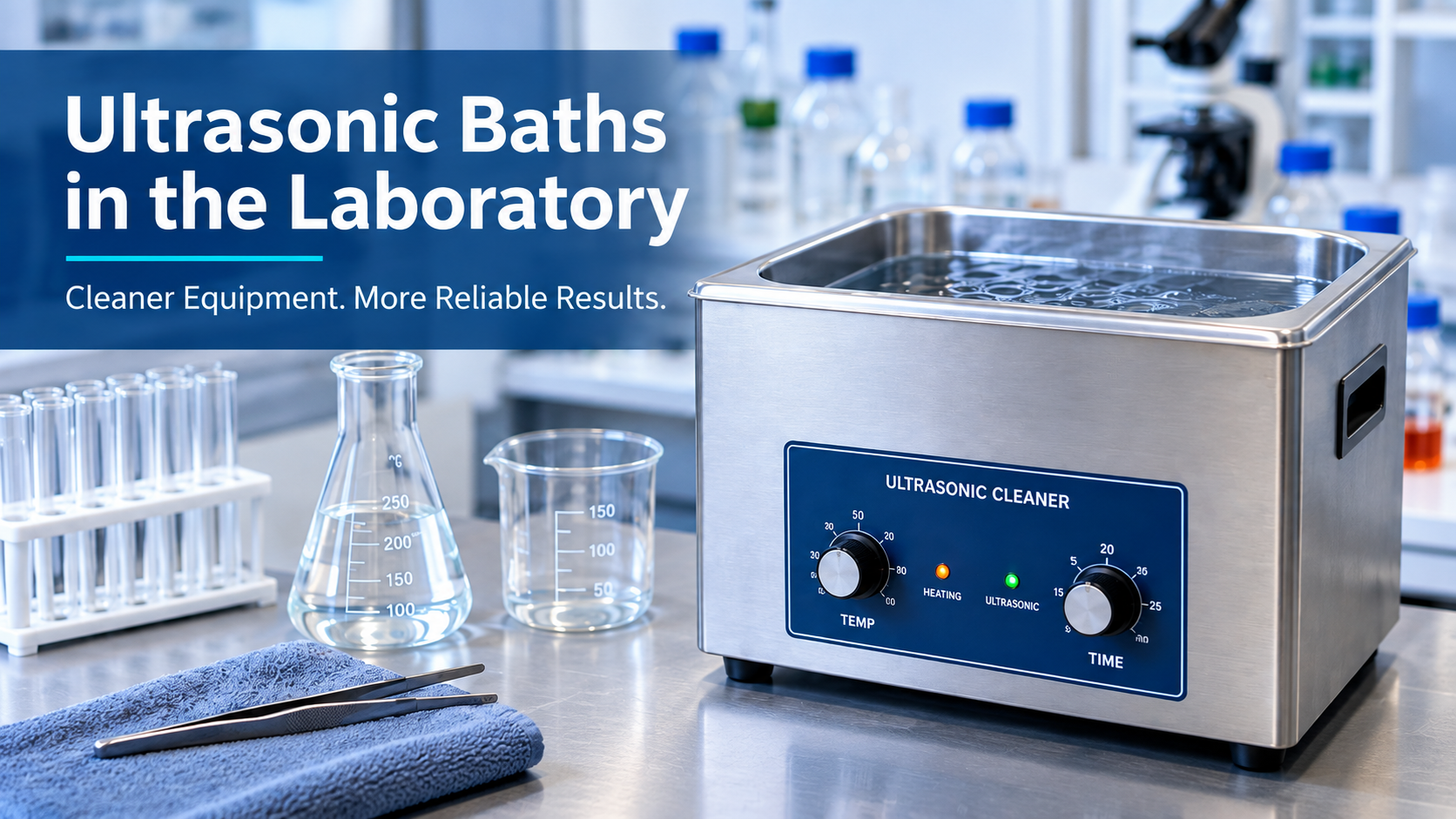
A laboratory ultrasonic bath, sometimes called an ultrasonic cleaner, uses high-frequency sound waves in a liquid cleaning solution to remove contaminants from equipment and components. The process can reach areas that brushes and conventional cleaning methods may struggle to access.
Ultrasonic baths are therefore useful across research laboratories, universities, industrial laboratories, quality-control facilities, healthcare environments and other scientific applications.
For laboratories evaluating new equipment or upgrading existing facilities, B&M Scientific offers a broad range of laboratory equipment and scientific products for different laboratory environments.
But how exactly does an ultrasonic bath work, and how do you determine which size is right for your laboratory?
How Does an Ultrasonic Bath Work?
The science behind ultrasonic cleaning is a process known as cavitation.
During operation, ultrasonic transducers generate high-frequency sound waves through the cleaning liquid inside the tank. These pressure waves cause millions of microscopic bubbles to form and collapse rapidly.
When these bubbles collapse against or near the surface of an item, they help dislodge contaminants attached to it.
This allows ultrasonic cleaning to reach intricate surfaces, narrow spaces and small openings that can be difficult to clean manually.
The US Centers for Disease Control and Prevention describes ultrasonic cleaning as a mechanical cleaning method in which acoustic energy creates cavitation that helps disrupt the bonds holding particles to surfaces.
Depending on the application and cleaning solution used, an ultrasonic bath can assist with removing:
- Dust and fine particles
- Oils and grease
- Chemical residues
- Biological material
- Polishing compounds
- Deposits on instrument components
- Dirt trapped in grooves, threads and small openings
The result is a cleaning process that can be both thorough and repeatable.
What Are Ultrasonic Baths Used for in Laboratories?
One of the advantages of ultrasonic cleaning equipment is its versatility. The same underlying technology can support several laboratory applications.
1. Cleaning Laboratory Glassware
Beakers, flasks, tubes and other reusable glassware can retain chemical residue even after conventional rinsing.
An ultrasonic bath can help loosen contamination from internal surfaces and difficult-to-reach areas.
For laboratories using glassware extensively, ultrasonic cleaning can therefore become part of a broader equipment cleaning and maintenance procedure.
Laboratories looking to improve the lifespan and reliability of their equipment can also read B&M Scientific’s guide on how to extend the life of laboratory instruments.
2. Cleaning Scientific Instruments and Components
Laboratory instruments often contain small components, narrow gaps or delicate surfaces.
Manual scrubbing may be impractical or potentially damaging in these situations.
Provided the item is compatible with ultrasonic cleaning, an ultrasonic bath can remove contamination while reducing the need for aggressive physical contact.
3. Sample Preparation
Ultrasonic baths are not used exclusively for cleaning.
Depending on the laboratory process, ultrasonic energy may also assist with activities such as:
- Sample dispersion
- Dissolution
- Degassing
- Extraction
- Homogenisation
- Mixing
For example, research facilities use ultrasonic baths for applications ranging from cleaning glassware to ultrasonic extraction and other sample-preparation procedures.
The suitability of ultrasonic treatment should always be assessed according to the sample, protocol and equipment specifications.
4. Cleaning Small Laboratory Tools
Reusable laboratory tools can accumulate residues after repeated use.
Ultrasonic cleaners may be suitable for certain stainless-steel instruments, laboratory accessories and compatible tools before they undergo additional cleaning, disinfection or sterilisation procedures.
It is important to distinguish cleaning from sterilisation. Ultrasonic cleaning removes contaminants, but equipment that requires sterilisation may still need to undergo an appropriate sterilisation process afterwards. The CDC notes that thorough cleaning is important before high-level disinfection or sterilisation because remaining organic or inorganic material can reduce the effectiveness of these processes.
5. Cleaning Small Mechanical Components
Engineering, research and industrial laboratories frequently work with components containing:
- Threads
- Small holes
- Narrow channels
- Grooves
- Complex geometries
These areas can be frustrating to clean by hand.
Because ultrasonic action occurs throughout the cleaning solution, it can reach areas that would otherwise require extensive manual cleaning.
What Are the Benefits of an Ultrasonic Bath?
Choosing the right laboratory ultrasonic cleaner can improve both cleaning quality and laboratory efficiency.
More Thorough Cleaning
One of the greatest advantages of an ultrasonic bath is its ability to clean intricate surfaces.
Instead of relying entirely on a brush or cloth touching a contaminated area, cavitation occurs throughout the cleaning liquid.
This can make ultrasonic cleaning especially useful for complex components.
Reduced Manual Cleaning
Cleaning equipment manually can consume valuable laboratory time.
An ultrasonic cleaner can reduce the amount of scrubbing required, allowing technicians and researchers to focus on higher-value laboratory activities.
Greater Cleaning Consistency
Repeatability matters in laboratory environments.
When cleaning time, temperature, solution and equipment settings are controlled, an ultrasonic bath can help laboratories develop more standardised cleaning procedures.
Suitable for Many Delicate Components
Mechanical scrubbing can sometimes scratch or damage sensitive surfaces.
For compatible materials, ultrasonic cleaning reduces the need for direct abrasive contact while still assisting with contaminant removal.
Multiple Items Can Be Cleaned Together
Depending on tank capacity and the items involved, several compatible components can often be cleaned during the same cycle.
This can improve efficiency in laboratories processing significant volumes of reusable equipment.
Supporting Longer Equipment Life
Reliable laboratory equipment represents a significant investment.
Routine cleaning and preventative maintenance can help prevent contaminants from accumulating and contributing to premature equipment deterioration.
This is particularly important when establishing or upgrading a laboratory. B&M Scientific’s guide to essential laboratory supplies for researchers provides additional guidance on laboratory equipment and consumables that support efficient research environments.
How to Choose the Right Ultrasonic Bath for Your Laboratory
Buying an ultrasonic bath should not simply involve selecting whichever model has the largest tank.
The best unit is the one that matches your laboratory’s actual cleaning requirements.
Consider the following factors before making your selection.
1. Start With What You Need to Clean
Ask a simple question first:
What will regularly go inside the ultrasonic bath?
Consider:
- The physical size of the equipment
- The material from which it is manufactured
- The type of contamination
- The number of items cleaned simultaneously
- The frequency of cleaning
- Whether the items contain narrow or difficult-to-reach areas
These requirements will influence the appropriate tank capacity, ultrasonic frequency and additional features.
2. Choose the Right Tank Size
This is one of the most important considerations when purchasing an ultrasonic bath.
Ultrasonic cleaners are available in different tank capacities, ranging from compact benchtop units to considerably larger laboratory systems.
A smaller unit may be suitable for occasional cleaning of small components, while laboratories processing multiple instruments or larger equipment may require greater capacity.
Don’t Look at Litres Alone
A common mistake is choosing an ultrasonic bath based only on its stated litre capacity.
Instead, check the internal tank dimensions.
For example, an item may fit within the theoretical volume of the tank but still be too long or wide to lie correctly inside it.
Before ordering a unit:
- Measure your largest regularly cleaned item.
- Determine how many items will normally be cleaned simultaneously.
- Compare these measurements with the usable internal tank dimensions.
- Allow enough space for the cleaning solution to circulate effectively.
A little additional capacity can also provide useful flexibility as the laboratory’s requirements grow.
3. Consider Ultrasonic Frequency
Different ultrasonic cleaning applications may require different frequencies.
In general, lower ultrasonic frequencies generate larger, more energetic cavitation bubbles, while higher frequencies create smaller bubbles that can provide gentler cleaning.
That means the correct frequency depends on factors such as:
- Surface sensitivity
- Type of contamination
- Component geometry
- Required level of cleaning
A laboratory cleaning robust metal components, for example, may have different requirements from one cleaning delicate precision parts.
4. Decide Whether You Need Heating
Some ultrasonic baths include built-in heating.
Heating can improve cleaning performance in particular applications, particularly when oils and grease are involved.
However, hotter is not automatically better.
Temperature must be appropriate for:
- The item being cleaned
- The cleaning solution
- The contaminant
- The manufacturer’s specifications
Laboratories should always follow the cleaning solution and equipment manufacturer’s temperature recommendations.
5. Look for an Adjustable Timer
An adjustable timer makes ultrasonic cleaning easier to standardise.
Instead of relying on staff to manually monitor each cycle, cleaning time can be set according to the laboratory’s procedure.
This is particularly useful for facilities that repeatedly clean similar components.
Digital controls may also provide greater precision where consistent operating parameters are required.
6. Check the Basket and Accessories
In many ultrasonic cleaning systems, components are placed inside a suitable basket rather than directly on the tank floor.
The basket:
- Helps position items correctly
- Prevents components from resting directly on the ultrasonic tank surface
- Makes loading and unloading easier
- Allows cleaning solution to circulate around the equipment
Depending on the application, laboratories may also require lids, specialised baskets or other accessories.
Check which accessories are compatible with the ultrasonic bath before purchasing.
7. Consider Construction and Durability
Laboratory equipment may be used repeatedly for several years.
Build quality therefore matters.
A robust stainless-steel tank, dependable controls and suitable components can contribute to longer service life and easier maintenance.
The cheapest ultrasonic cleaner may not necessarily offer the best long-term value if it cannot withstand the laboratory’s workload.
When comparing equipment, consider total value over the expected operating life, rather than purchase price alone.
How Do You Determine the Right Ultrasonic Bath Size?
The ideal ultrasonic bath size depends primarily on what you need to clean and how much you need to clean at once.
As a simple guide:
| Laboratory requirement | Typical consideration |
|---|---|
| Small components and occasional use | Compact benchtop bath |
| Regular glassware or instrument cleaning | Medium-capacity bath |
| Several components per cycle | Larger-capacity bath |
| Large equipment or high-volume laboratory use | Heavy-duty/larger laboratory unit |
These categories are only a starting point. Physical tank dimensions and equipment specifications should ultimately guide the decision.
Buying a substantially oversized bath can also create unnecessary costs because a larger unit may require:
- More cleaning solution
- More bench space
- Greater energy consumption
- Longer preparation or heating times
The goal is therefore not to purchase the largest ultrasonic bath available.
It is to choose the smallest unit that comfortably meets the laboratory’s normal and anticipated cleaning requirements.
Ultrasonic Bath Safety: What Laboratories Should Know
Like all laboratory equipment, ultrasonic cleaners should be used according to proper operating and safety procedures.
Important precautions include:
- Follow the manufacturer’s operating instructions.
- Use only compatible cleaning solutions.
- Use appropriate personal protective equipment.
- Check material compatibility before cleaning delicate components.
- Do not place your hands into an operating ultrasonic bath.
- Keep electrical components and controls dry.
- Replace contaminated cleaning solutions as required.
- Follow the recommended operating temperature.
- Properly decontaminate potentially infectious items before ultrasonic cleaning where required.
The CDC recommends covering bath sonicators during certain laboratory applications and highlights the importance of appropriate decontamination and management of bath fluids, particularly where biological materials are involved.
Laboratories should also remember that equipment manufacturer instructions take priority because compatibility, temperatures and acceptable cleaning solutions vary between systems.
Ultrasonic Bath vs Manual Cleaning: Which Is Better?
Manual cleaning still has an important place in laboratories.
However, ultrasonic cleaning becomes particularly valuable when equipment contains intricate surfaces or when laboratories need a repeatable process for cleaning several components.
Rather than viewing the two methods as competitors, laboratories can use each where it provides the greatest benefit.
Manual cleaning may be appropriate for simple items and visible contamination, while ultrasonic cleaning can provide additional effectiveness for difficult geometries and inaccessible areas.
Frequently Asked Questions About Laboratory Ultrasonic Baths
What is an ultrasonic bath used for in a laboratory?
An ultrasonic bath uses high-frequency sound waves and cavitation to assist with cleaning laboratory glassware, instruments and components. Depending on the application, ultrasonic baths may also be used in processes such as dispersion, degassing, extraction and sample preparation.
Can you put laboratory glassware in an ultrasonic bath?
Many types of compatible laboratory glassware can be cleaned ultrasonically. However, laboratories should consider the condition and material of the glassware and follow the equipment manufacturer’s instructions.
Does an ultrasonic bath sterilise equipment?
Not necessarily. Ultrasonic cleaning primarily removes contamination and debris. Where equipment requires sterilisation or high-level disinfection, an appropriate additional process may still be necessary.
What size ultrasonic bath should I buy?
Measure the largest item you regularly intend to clean and compare it with the ultrasonic bath’s internal tank dimensions. Also consider how many items must be processed during each cleaning cycle.
Should an ultrasonic bath have a heater?
A heated ultrasonic bath can be useful for certain cleaning applications, particularly where oils or grease need to be removed. However, heating requirements depend on the cleaning solution, item being cleaned and manufacturer’s recommendations.
Choosing the Right Laboratory Equipment Partner
An ultrasonic bath may look like a relatively straightforward piece of equipment, but choosing the right unit can have a noticeable impact on cleaning efficiency, laboratory workflow and equipment maintenance.
Tank size, internal dimensions, ultrasonic frequency, heating capability, controls, accessories and build quality all deserve consideration.
More importantly, equipment should be selected according to the actual application rather than specification sheets alone.
Find the Right Ultrasonic Bath with B&M Scientific
B&M Scientific supplies a wide range of laboratory equipment, consumables, glassware, chemicals and scientific products to laboratories and organisations across South Africa.
Whether you are setting up a new laboratory, replacing ageing equipment or expanding your existing capabilities, selecting equipment suited to your application can help improve efficiency and protect your laboratory investment.
If you are uncertain about the capacity or specifications your laboratory requires, speak to the B&M Scientific team about your application.
Explore B&M Scientific’s laboratory equipment range or contact B&M Scientific for assistance with choosing suitable laboratory equipment.
Equip your laboratory for accurate, efficient and dependable work with B&M Scientific.