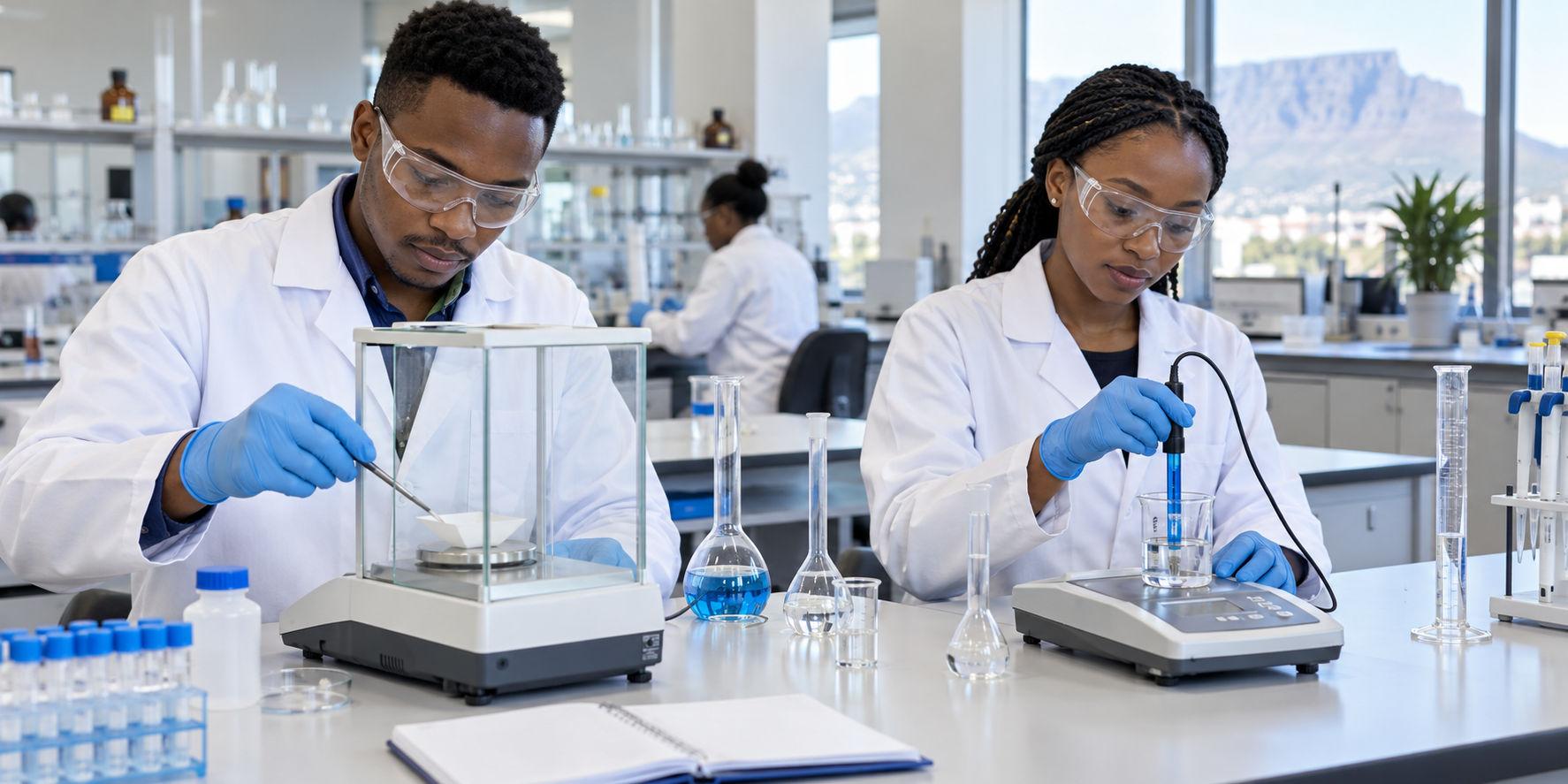
Analytical balances play an essential role in ensuring accurate and credible scientific teaching and research. From preparing standard solutions during undergraduate chemistry practicals to analysing samples in postgraduate research, the quality of every result depends on a reliable measurement process.
For universities, selecting laboratory measuring equipment involves much more than comparing prices. Laboratory managers and procurement teams must consider accuracy, capacity, calibration, ease of use, maintenance requirements and the scientific applications each instrument will support.
This guide explores how universities can select analytical balances, pH meters and volumetric measuring equipment that meet the needs of students, technicians and researchers.
Why accurate laboratory measurement matters

Every laboratory measurement contains some degree of uncertainty. The objective is not to pretend that uncertainty does not exist, but to understand, control and document it.
Research published in the Journal of Chemical Education explains that incorporating measurement uncertainty into laboratory education can strengthen students’ critical thinking and practical skills. The researchers note that uncertainty may arise from repeatability, instrument readability, reference materials and the tolerances of volumetric equipment. This makes appropriate equipment and proper training equally important in a university setting. Read the research on measurement uncertainty in laboratory education.
When equipment is poorly selected, incorrectly calibrated or used outside its intended range, errors can affect concentrations, reaction conditions and final conclusions. Reliable measuring instruments help universities improve consistency across practical classes while supporting the reproducibility of advanced research.
Universities reviewing their instrumentation can also consult B&M Scientific’s guide to accuracy and calibration in academic research laboratories for additional guidance.
Analytical balances for university laboratories
An analytical balance is used when a laboratory needs to determine mass with a high degree of precision. These instruments are commonly found in university chemistry, biochemistry, biotechnology, pharmaceutical and food science laboratories.
They may be used to prepare reference standards, formulate solutions, weigh research samples and support quantitative analysis. However, the most sensitive balance is not automatically the best option for every department. The right instrument depends on the amount being weighed, the accuracy required and the conditions in which it will operate.
What should a university consider when choosing an analytical balance?
Start by defining the intended application. A balance used by first-year students for routine practical work may have different requirements from one used for advanced analytical research.
The balance’s maximum capacity must accommodate both the sample and its container. Its readability must also be suitable for the smallest quantity the laboratory expects to measure. Procurement teams should avoid choosing an instrument based only on the number of decimal places shown on its display. Repeatability, calibration, stability and suitability for the working environment also affect the quality of a weighing result.
Environmental conditions deserve particular attention. Draughts, vibration, static electricity, humidity and temperature changes can cause readings to fluctuate. Research into the reproducibility of weighing found that day-to-day variation and environmental factors, including humidity, can contribute to measurement uncertainty. The findings highlight why balance location, routine checks and quality-control procedures are important. See the study on reproducibility and uncertainty in weighing.
An analytical balance should be installed on a stable, level surface, away from doors, busy walkways, open windows and equipment that produces vibration. Users should allow samples to reach the appropriate temperature and avoid handling weighing containers in ways that may transfer heat, moisture or contaminants.
Selecting a pH meter for teaching and research
A pH meter determines how acidic or alkaline a solution is. It is widely used in chemistry, microbiology, environmental science, agriculture, food science, biotechnology and health-related research.
Indicator paper is useful when students need a quick estimate, but it cannot replace a pH meter when an experiment requires a precise numerical reading. A suitable meter can improve the consistency of solution preparation, water analysis, culture conditions and chemical testing.
B&M Scientific supplies benchtop pH meters capable of measuring pH, millivolts and temperature, making them appropriate for a variety of university laboratory applications.
Accuracy depends on more than the meter
The condition of the electrode, the quality of the buffer solutions and the temperature of the sample all influence pH measurement. A good instrument can still provide unreliable results if it is poorly calibrated or if its electrode has been incorrectly stored.
The US National Institute of Standards and Technology explains that certified reference materials are used to calibrate electrodes and improve confidence in pH measurements. It also provides certified pH values across defined temperatures, demonstrating that temperature must be considered during calibration and measurement. Read more about NIST reference materials for pH calibration.
A university laboratory should establish a clear operating procedure for its pH meters. This procedure should specify when calibration must be performed, which buffers should be used, how the electrode should be rinsed and stored, and how calibration results should be documented.
For shared teaching laboratories, simple controls can make a significant difference. Clear instructions displayed near the instrument, labelled buffer solutions and scheduled electrode inspections can reduce user errors and extend equipment life.
Volumetric glassware and liquid measurement
Electronic instruments are only one part of accurate laboratory measurement. Universities also depend on volumetric flasks, pipettes and measuring cylinders when preparing and transferring liquids.
A volumetric flask is designed to prepare a solution at a defined volume. A volumetric pipette transfers a specified quantity of liquid, while a measuring cylinder is generally used when a reasonable volume estimate is sufficient. Beakers and measuring jugs are valuable for holding, mixing and transferring liquids, but they should not be treated as precision measuring instruments.
B&M Scientific supplies volumetric flasks, pipettes and measuring cylinders in various sizes, including Grade A and Grade B options.
Grade A glassware is manufactured to tighter tolerances and is normally selected for work requiring greater accuracy. Grade B glassware may be suitable for routine demonstrations, general teaching and applications where the permitted tolerance is wider. Many universities will need a combination of the two rather than applying a single grade across every department.
Matching equipment to the university laboratory
A productive procurement process begins with the scientific application, not the product catalogue. Laboratory managers should determine what will be measured, the required level of accuracy, the expected frequency of use and the experience of the people who will operate the equipment.
In a high-volume undergraduate laboratory, durability and ease of use may be particularly important. A postgraduate research facility may place greater emphasis on sensitivity, measurement uncertainty and data quality. Shared facilities may also require equipment that can serve several departments without compromising essential specifications.
Universities should consider after-sales support, calibration requirements, consumable availability and the total cost of ownership. The cheapest initial option may become expensive if it is frequently unavailable, difficult to maintain or unsuitable for the required method. B&M Scientific’s article on what universities should look for in a laboratory equipment supplier provides a useful framework for evaluating potential suppliers.
Calibration, maintenance and student training
Calibration confirms how an instrument performs against an accepted reference. Maintenance helps preserve that performance, while training ensures that users do not introduce unnecessary errors.
These activities should form part of one measurement-management process. A university laboratory should keep equipment records showing calibration dates, maintenance work, faults and corrective actions. Instruments that fail a routine check should be clearly identified and removed from use until they have been assessed.
Training is equally important. Students should understand why a balance must be level, why a pH electrode must remain properly hydrated and why a volumetric flask should be read at eye level. When students understand the reason behind a procedure, they are more likely to apply it consistently in future scientific work.
Building reliable university laboratories
Analytical balances, pH meters and volumetric equipment support some of the most fundamental activities in university science. Choosing the right instruments can improve practical teaching, strengthen research quality and help laboratories produce results that are easier to verify and reproduce.
B&M Scientific supplies analytical balances, precision balances, benchtop pH meters, thermometers, data loggers, volumetric flasks, pipettes, measuring cylinders and other essential laboratory equipment. Our team can help university procurement departments and laboratory managers identify suitable products for their teaching and research requirements.
Contact B&M Scientific to discuss your university laboratory equipment needs or request a quotation. Request a quote. Click here
Website: www.bmscientific.co.za