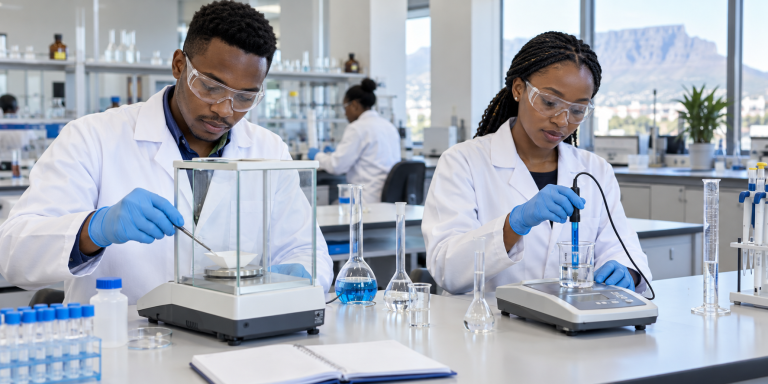
Every successful laboratory has stories that extend far beyond the equipment, experiments and results produced within its walls.
There are researchers analysing samples late into the afternoon. Scientists developing new treatments. Laboratory technologists ensuring that tests are accurate. Engineers designing new technologies. Academics mentoring the next generation. And increasingly, women are playing central roles across every part of this scientific ecosystem.
During Women’s Month in South Africa, it is worth looking beyond celebration and asking a more important question:
What role do women play in modern laboratories, and what would science look like without their contribution?
The answer is straightforward. Women are not simply participants in science. They are researchers, laboratory specialists, innovators, educators, entrepreneurs and scientific leaders helping to shape the future of healthcare, biotechnology, agriculture, environmental science, chemistry, food science and countless other fields.
South Africa has recognised this contribution through initiatives such as the South African Women in Science Awards (SAWiSA), which in 2026 marks its 20th anniversary. The Department of Science, Technology and Innovation has chosen the theme “Placing Women at the Centre of Science, Technology and Innovation”, highlighting the importance of women’s contribution to the country’s scientific and innovation ecosystem.
For laboratories, this conversation matters because scientific progress depends on people as much as it depends on instruments.
Women Have Always Been Part of Scientific Progress
The history of science contains numerous examples of women whose discoveries changed how we understand the world.
Marie Curie transformed our understanding of radioactivity and became the first woman to receive a Nobel Prize. Dorothy Crowfoot Hodgkin used X-ray crystallography to determine the structures of important biochemical molecules, including penicillin and vitamin B12.
Rosalind Franklin’s work with X-ray diffraction provided crucial evidence that helped scientists understand the structure of DNA.
These achievements were not simply academic milestones. They changed medicine, chemistry, biology and the way researchers approach scientific problems.
Yet the story of women in science is much broader than a handful of famous names.
Every day, women working in laboratories contribute to thousands of research projects, diagnostic processes, quality-control programmes and scientific discoveries that may never make international headlines.
That work matters.
What Role Do Women Play in Modern Laboratories?
The modern laboratory is a complex environment requiring multiple skills and disciplines.
Women can be found across virtually every part of that environment.
1. Women as Laboratory Researchers
Research laboratories depend on people who can formulate questions, develop methodologies, analyse results and interpret evidence.
Women researchers contribute to fields ranging from molecular biology and genetics to chemistry, environmental science and biomedical research.
Their work can involve anything from studying disease mechanisms and developing pharmaceutical compounds to investigating food safety, environmental contamination and new materials.
Research is ultimately about solving problems, and diverse teams bring different experiences, perspectives and approaches to those problems.
That diversity can be valuable when laboratories are tackling complex scientific questions.
2. Women in Medical and Diagnostic Laboratories
Laboratory science is also fundamental to healthcare.
Blood tests, microbiological testing, pathology, molecular diagnostics and other laboratory services provide information that healthcare professionals rely on when making clinical decisions.
Women occupy important roles throughout these environments, including as laboratory scientists, technologists, researchers, managers and quality specialists.
Their work may happen behind the scenes, but its impact can reach directly into patient care.
A laboratory result might appear on a page as a number, measurement or diagnosis. Behind that result can be a chain of people, procedures, instruments and quality-control processes.
Women are an important part of that chain.
3. Women in Biotechnology and Life Sciences
Biotechnology has become one of the most exciting areas of modern science.
Researchers are exploring genetic technologies, vaccines, diagnostics, agricultural biotechnology, biomaterials, biopharmaceuticals and other applications that could transform healthcare and industry.
Women scientists are contributing to this rapidly evolving field as researchers, entrepreneurs, laboratory specialists and scientific leaders.
This is particularly significant for Africa, where biotechnology and life sciences have the potential to contribute to healthcare, food security, environmental sustainability and economic development.
The laboratory is where many of these possibilities move from an idea into an experiment.
And women are increasingly helping to lead that journey.
4. Women in Chemistry

Chemistry laboratories require precision, patience, analytical thinking and rigorous attention to detail.
Women chemists work across pharmaceutical research, materials science, food testing, environmental analysis, industrial chemistry and academic research.
Their work can involve developing new compounds, analysing substances, testing materials or improving industrial processes.
Chemistry also demonstrates why access to appropriate laboratory equipment matters.
A scientist can have an excellent research question, but reliable experiments require appropriate glassware, chemicals, analytical equipment, consumables and laboratory infrastructure.
This is one reason B&M Scientific believes in supporting laboratories with products and solutions that help scientists do their work effectively.
5. Women as Laboratory Leaders
Perhaps one of the most important developments is the growing visibility of women in scientific leadership.
Being a scientist is one thing.
Leading a laboratory, research programme, scientific institution or innovation project is another.
Scientific leadership involves managing people, securing funding, developing research strategies, maintaining quality standards, mentoring younger scientists and making decisions that can influence an entire organisation.
South Africa’s SAWiSA programme specifically recognises distinguished women researchers and young women researchers, while also using these scientists as role models for younger women considering careers in science.
This visibility matters.
A young woman considering a career in science needs to be able to see that career as something she can actually achieve.
The Importance of Female Role Models in Science
Representation has a powerful effect on aspiration.
When students see women leading laboratories, publishing research, developing technologies and receiving recognition for scientific excellence, the message becomes tangible:
There is a place for me here.
That is one of the purposes behind initiatives such as SAWiSA.
The South African government describes the awards as a way of recognising women’s scientific achievements while raising their profile as role models for younger women and girls interested in STEM careers.
This is particularly important because scientific careers can seem distant to young learners.
A laboratory may look intimidating from the outside: microscopes, centrifuges, chemicals, protective equipment and complicated instruments.
But behind every laboratory is a human story.
Someone had to decide to study science.
Someone had to conduct the first experiment.
Someone had to ask the question that nobody else had asked.
And that someone can be a woman.
Women and Scientific Innovation
Innovation is not restricted to technology companies or engineering laboratories.
Scientific innovation happens every time researchers find a better way to understand a problem, improve a process or develop a new solution.
Women scientists are contributing to innovation across disciplines.
The 2026 SAWiSA programme includes a special category titled “Innovation for Impact: Women Leading Change”, reflecting the growing recognition that scientific innovation can have practical social and economic consequences.
This is an important distinction.
Scientific success should not only be measured by the number of papers published.
It can also be measured by whether research improves healthcare, makes food safer, protects the environment, creates new technologies, strengthens industry or improves people’s quality of life.
The Laboratory Is Also a Place of Collaboration
Science is rarely a one-person operation.
Modern research frequently involves multidisciplinary teams bringing together biologists, chemists, medical scientists, engineers, data scientists, technicians and other specialists.
Women contribute to these teams not only through technical expertise but also through collaboration, mentorship, communication and leadership.
A successful laboratory depends on people being able to work together.
The most sophisticated equipment in the world cannot compensate for poor collaboration.
The same principle applies in scientific supply chains.
Researchers depend on laboratory suppliers to provide the equipment, consumables, chemicals, glassware and other products needed to keep their work moving.
That makes the relationship between scientists and laboratory suppliers an important part of the broader scientific ecosystem.
Supporting Women in Science Requires More Than Recognition
Celebrating women scientists once a year is valuable.
But recognition alone is not enough.
If South Africa wants more women to enter and remain in science, the scientific ecosystem needs to support women throughout their careers.
That means creating opportunities for:
- STEM education and training
- Laboratory experience
- Research funding
- Mentorship
- Scientific networking
- Leadership development
- Entrepreneurship
- Career progression
- Access to appropriate laboratory infrastructure
- Recognition of scientific achievements
It also means making scientific careers visible to girls while they are still considering their future.
A girl who sees a woman running a laboratory, leading a research team or developing a scientific product is seeing a possible future for herself.
Women Are Shaping the Future of African Science
Africa faces some of the world’s most complex scientific challenges.
From infectious diseases and food security to climate change, water management, agricultural productivity and sustainable development, the continent needs scientific expertise capable of addressing problems within African contexts.
Women scientists have an essential role to play in this future.
Their participation strengthens the scientific community and expands the pool of talent available to solve complex problems.
For South Africa in particular, developing a strong pipeline of women in STEM is not simply a question of representation.
It is an investment in the country’s research capacity, innovation ecosystem and economic future.
What Does This Mean for Laboratory Suppliers?
For companies such as B&M Scientific, supporting science means supporting the people who conduct it.
Laboratory equipment, chemicals, glassware, plastics, consumables and other supplies may seem like individual products, but collectively they form the infrastructure that allows scientific work to happen.
A researcher needs reliable equipment.
A student needs access to appropriate laboratory supplies.
A diagnostic laboratory needs dependable consumables.
A research institution needs a supply chain capable of supporting long-term scientific programmes.
And every one of those environments needs talented people.
That includes women.
At B&M Scientific, we recognise that behind every laboratory bench is a person asking questions, testing ideas, solving problems and contributing to something larger than the experiment in front of them.
Celebrating the Women Behind the Laboratory Bench
Women’s Month provides an opportunity to recognise the women whose work keeps science moving.
Some are professors.
Some are researchers.
Some are laboratory technologists.
Some are students conducting their first experiments.
Some are managing laboratories.
Some are building scientific businesses.
Some are working quietly behind the scenes, ensuring that samples are processed correctly and results meet required standards.
Their titles may differ.
Their disciplines may differ.
Their laboratories may look completely different.
But they share something important: they are contributing to the advancement of science.
The future laboratory will require more than sophisticated instruments and advanced technologies. It will require talented people with curiosity, creativity, technical expertise and the determination to solve difficult problems.
Women are already bringing those qualities into laboratories across South Africa and around the world.
The task now is not simply to celebrate their contribution.
It is to make sure the next generation has even more opportunities to follow in their footsteps.
Frequently Asked Questions
Why are women important in laboratory science?
Women contribute across laboratory research, diagnostics, biotechnology, chemistry, healthcare, food science, environmental science and other disciplines. Their participation strengthens the scientific talent pool and brings diverse perspectives to complex research challenges.
What is South Africa doing to support women in science?
The Department of Science, Technology and Innovation runs the South African Women in Science Awards (SAWiSA), which recognises outstanding women scientists and researchers and promotes them as role models. The 2026 theme is “Placing Women at the Centre of Science, Technology and Innovation.”
What careers can women pursue in laboratory science?
Women can pursue careers as laboratory scientists, research scientists, medical laboratory scientists, chemists, microbiologists, biotechnologists, research managers, laboratory technologists, academics, quality specialists and scientific entrepreneurs, among many other roles.
Why are role models important for women in STEM?
Visible female scientists can help young women understand that careers in science, technology, engineering and mathematics are realistic possibilities. Recognition programmes such as SAWiSA deliberately profile accomplished women scientists as role models for younger generations.
How can laboratories support women in science?
Laboratories can support women through mentorship, training, professional development, equitable opportunities, leadership pathways, access to research resources and inclusive working environments.
The Future of Science Has Her Name Written All Over It
A laboratory is a place where questions become experiments and experiments become knowledge.
Across South Africa, women are helping to make that transformation happen.
They are examining samples, developing medicines, analysing data, conducting experiments, managing laboratories, mentoring students, building companies and pushing the boundaries of what science can achieve.
This Women’s Month, B&M Scientific celebrates not only the women who have already changed science, but also the young women standing at the beginning of their scientific journeys.
The next breakthrough could come from a laboratory at a university.
It could come from a medical research facility.
It could come from an industrial laboratory.
It could come from a young scientist conducting her first experiment.
And when that happens, we should remember something simple:
Women do not merely have a place in the laboratory. They are helping to define what the laboratory of the future will become.
B&M Scientific: Supporting the people, products and possibilities behind modern laboratory science.